Airport Art: Women in Afrofuturism at SFO
Women in Afrofuturism at San Francisco International Airport
Curated by Ingrid LaFleur
I’m always on the hunt for art in airports. It’s a welcome reprieve to the store fronts and fast food. In particular I like ceiling installations because they’re often site specific - reflecting something about the airport or city where it’s installed. It’s art that you can appreciate even if you only see it walking by because you have no time to sit and observe while you race to your connecting flight. Many airports will feature a collection in a sitting area offset from the gates in the terminal, but I’ve been to some airports that have no visible art at all save from advertising.
Art is a series of choices: the medium it’s created with, the subject it depicts, the techniques used to portray that subject, and the most important choice - when to stop and consider a piece complete. The art that is displayed and the way it is displayed expands the conversation beyond the singular work to its impact and interaction with other art and the world around it. Some airports choose photographs of the local city or larger state - exposing viewers to a preview of the place they’re visiting or a sample of a city they won’t see as they pass through on a connecting flight. Some galleries are filled with artwork by students, some terminals are framed by large murals, some include displays by the history of aviation. The presence (or absence) of art shows you what matters to the people who decide what belongs in the airport.
San Francisco International Airport was covered with art. I was delighted after a long day of travel to see multiple ceiling installations and wrap around murals as I exited. I was determined to save extra time to explore when I returned for my flight home and I’m so grateful that I planned ahead because art was more than wall decor in this airport - they have an entire museum.
Tucked away in Terminal C and easy to overlook was the SFO Museum. This small museum was a less than 20 yard path between the main thoroughfare and a sitting area behind Ritual Coffee. I had already walked by it once without noticing but didn’t miss it when I doubled back for coffee and saw the name of the current showing: “Women of Afrofuturism”. As a lover of science fiction - a genre where black people are often severely underrepresented - I was immediately beckoned to explore further. The sign for the exhibit featured digital artwork by Nettrice Gaskins with a woman looking up and out to the right of the composition. She stands before a background that appears both woven like a textile and soldered like the wires of a computer chip. Donned in regal garb that adorns her collar bones and drapes behind her back we see a display of opulence that is common in traditional African formal wear, but infrequent in most futuristic attire that favors minimal, militaristic, jumpsuits. Her gaze is intent as she seems to stride into the gallery, and into a future that we’re invited to see inside. The walls of the gallery were black and with the tunneled shape of the museum walking in felt like entering the vacuum of space or maybe even a wormhole to an alternate timeline. The path was illuminated by recessed lamps in the ceiling and light that shone out from art displays encased behind glass along one side of the walk way and information panels describing the exhibit.
As you embark on your journey through this pocket of space you’re caught in the gaze of an aquamarine woman draped in gold, looking coyly over her shoulder. As you move past her eyes flutter open and closed. This holographic illusion by Celia C Peters is paired with an excerpt of more moving illustrations, as her animation plays on a screen below.
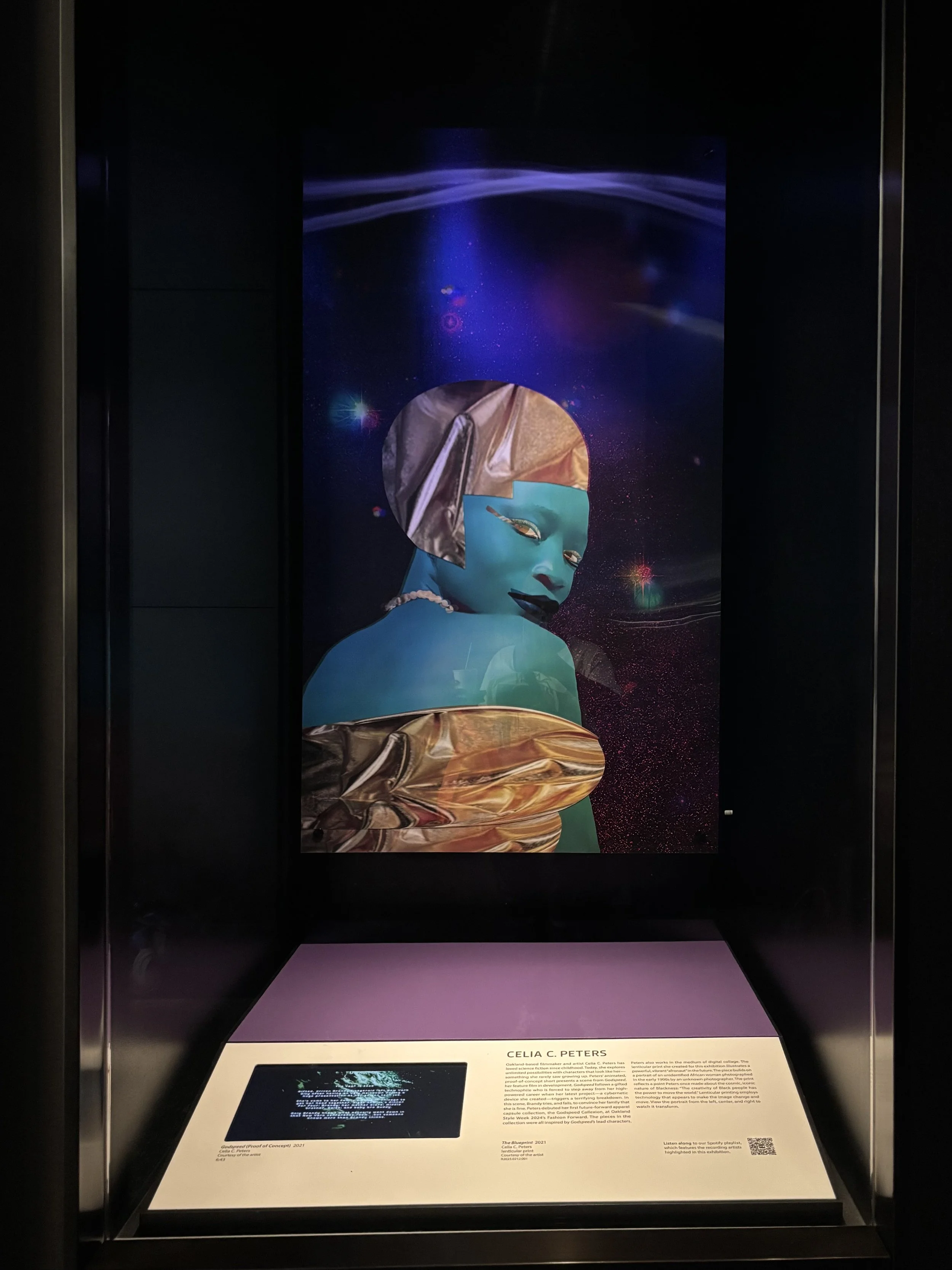
Another illuminated panel provides information about the history of afrofuturism in literature, music, and tv. The artists that embodied afrofuturism in their creative process impacted the real world with their fictional imaginings. We’re also briefly introduced to the other artists whose work is featured in the exhibit and the curator behind the collection - Ingrid LaFleur.
As I moved to the next display tears began to sting my eyes peering into a digital portrait of Octavia Butler by Nettrice Gaskins. Acclaimed as the mother of afrofuturism, Butler began writing stories where she could see herself in the characters. The stories she read didn’t include her so Butler said she would write herself in. Octavia Butler didn’t set out to be a prolific science fiction writer but her work went on to win a number of awards and inspire many other authors and creatives - me included. Copies of Butler’s books appear alongside her typewriter and other afrofuturistic novels by women.

This particular display contained the most art by a variety of artists because it included a number of mediums to portray the timeline and development of Afrofuturism and it’s impact on the world. For example along alongside the portrait of Octavia Butler was an image of Katherine Johnson the real mathematician whose calculations facilitated the first moon landing, Aurora, the fictional engineer in Star Trek, and Mae Jemison, the first black woman astronaut.
Beneath the portraits were gadgets from the past of an imagined future - turntables with housing that resembled a colorful mac computer and a tv that resembled a space helmet. To the right of the portraits were vinyl records featuring afrofuturistic art and highlight black women musicians that embodied this theme in their writing. In perfect symmetry to Octavia Butler and the literary descendants that followed in her steps, these records are placed beneath a portrait of Alice Coltrane, the mother of afrofuturism in music.
At the corner of the exhibit a large banner displays a statement written in all caps with white letters on the background “THERE ARE BLACK PEOPLE IN THE FUTURE”. With this piece Alisha B Wormsley proved that the truth, put plainly, will always be a revolutionary act when it challenges a power structure built on illusion. The illusion that racism is a problem of the past when even fictional depictions of the future show a homogeneous population absent of black people. The information card detailed the backlash caused by this statement when it appeared on billboards for the first time in Pittsburgh and its future features in protests and media. Placed at the center of the gallery the piece succinctly articulates the point of the entire show. The reason afrofuturism exists, the reason it even needs to be stated that black people exist in the future is only because of the pattern of excluding them from a narrative of possibility. The women that contributed to this exhibit as artists or depicted by the art challenged that narrative and Alisha B Wormsley asserted that black people’s presence was not a possibility, rather a matter of fact.
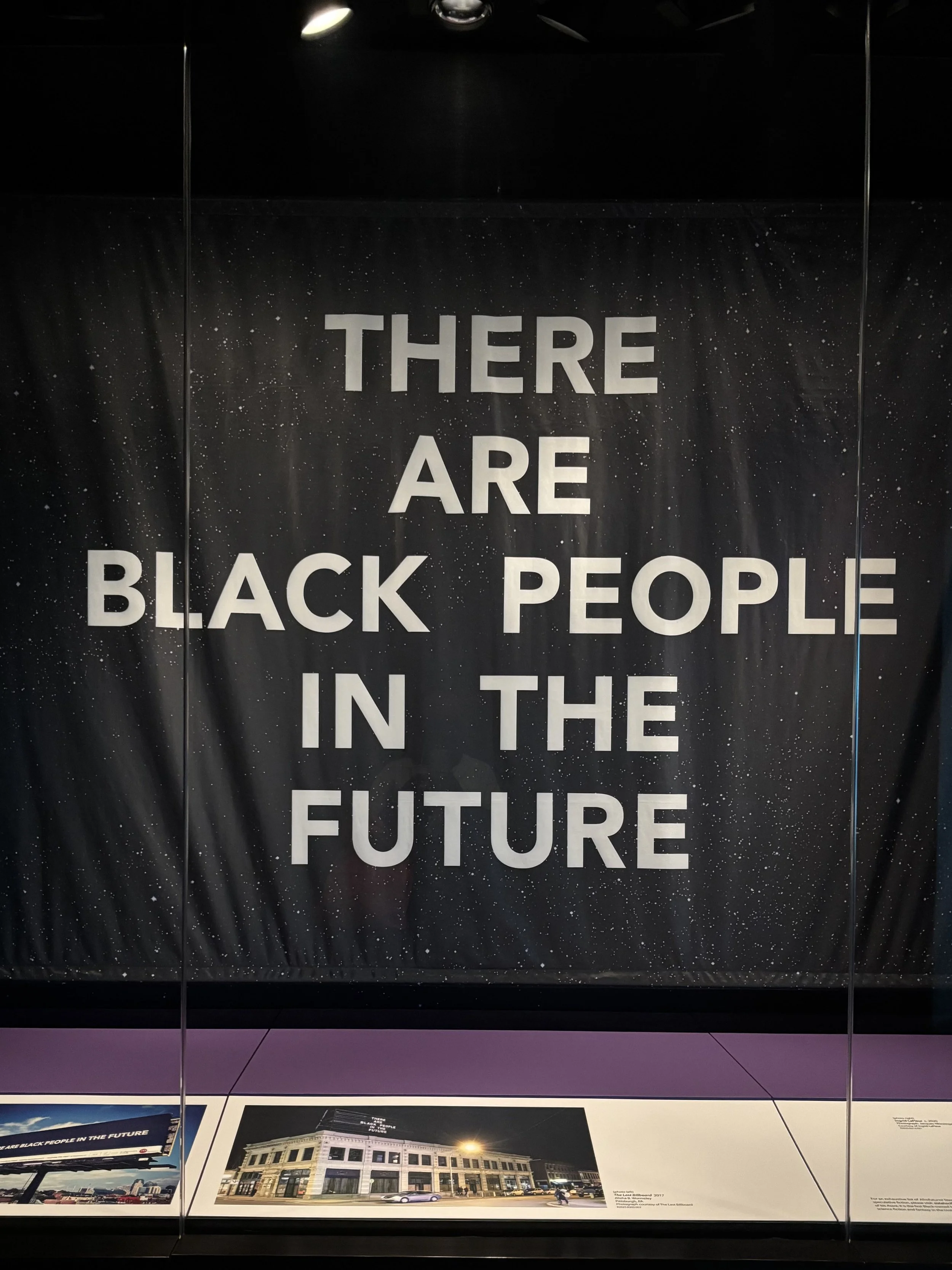
I’ll admit that at this point in the show I was feeling pretty overwhelmed with emotions so my observations of the remaining works is more brief. It is not a reflection of its impact, and is part of the reason I spend so much time revisiting museums and collections because I can only digest so much of the work at a time.
The remainder of the exhibit was like viewing models on a runway or maybe just grabbing coffee along with other fashion forward people in a not so distant future. The metal work hung upon the walls and apparel by Afatasi the Artist was vibrant and colorful, a welcome departure from the greigification that is common in many future imaginings of gray or black jumpsuits. Two sets with similar silhouettes: a knee length pull over with a kangaroo pocket over pants with wide flare. The set on the left a patchwork/quilt style with Stars and Stripes emblematic of the American flag on the set on the right with pictures of the planets and a contrasting pocket. The set on the left also had a sprawling red and blue headpiece with a star in its center. Nationalist pride seems reserved for Christian Nationalism and aligned with White Supremacist Ideology so for people descendant of the African Diaspora finding pride in America, the only place we’ve called home, is not always easy. The history of chattel slavery and the racism that has persisted since slavery’s abolishment seem to exclude black people from the American dream. I don’t know if the Stars and Stripes were included with this fraught relationship in mind, but it made me think of a future where black people and black women can wear these symbols with pride rather than disdain or as perceived imposters.
Professor D. Denenge Duyst-Akpem created a backdrop, cape, collar, and wristlets with her leaf illustrations that inquire how we truly survive and fit into an increasingly urban landscape. Further, how do we reimagine a sustainable and equitable future?
The exhibit closed (or opened depending on how you entered the museum) with another digital illustration by Nettrice Gaskins. There was much more information about each of the artists and the meaning behind their works. Even this small exhibit could have easily filled an hour and it was time I did not have. Exploring Women of Afrofuturism left me with a warm sense of pride and bristling with excitement of the possibilities that lied ahead. I know there are black people in the future and saw how pioneers of the past shaped our present so with these big questions answered I left questioning what would be in the museum in my next visit to SFO or if another airport could top this experience.
